
You wake up and something is wrong. Maybe it has been wrong for months. Maybe years. And so you do the thing you were always told to do — you go to a doctor. You trust the system. You believe in medicine. And then, slowly, you learn that belief alone is not enough to survive it.
This is not a piece about rare tragedies or isolated failures. This is about something far more ordinary — and far more dangerous. This is about a pattern. A system. A machine that takes the sick, the scared, and the vulnerable, runs them through a process dressed up in the language of care, and returns them, often, with less than they came in with: less money, less hope, less certainty that their suffering is even real.
We need to talk about it — plainly, loudly, and without the usual diplomatic distance that lets powerful institutions pretend the problem is complicated when it is, in fact, quite simple. People are sick. People need care. Care exists. But between those two facts sits an industry — and that industry's incentives are not aligned with your health.
What Illness Actually Costs in 2026
Let's start with money, because the system certainly does. Healthcare costs have not merely risen — they have become their own crisis, entirely separate from the medical one they were built to address. In the United States, a single hospitalization can hollow out a savings account. In the UK, the NHS — once the global gold standard of universal care — buckles under underfunding while privatisation quietly expands through the back door. In India, Southeast Asia, much of Africa, and Latin America, the private sector has moved into the space that public health abandoned, and it charges accordingly.
Insurance was supposed to be the answer. It was sold to us as protection — a promise that when the worst happened, we wouldn't face it alone and penniless. What it has become is something almost unrecognizable from that original pitch.
"The premium goes up every year. What goes down, quietly, every year, is what they actually cover."
Deductibles have climbed into the thousands. Out-of-pocket maximums — the theoretical ceiling on what you can be asked to pay — are set so high they function more as a distant promise than a real protection. And that's before the claim denials start. Before the exclusions. Before the "prior authorization" process that asks your doctor to justify to an accountant why you should receive the treatment they've prescribed.
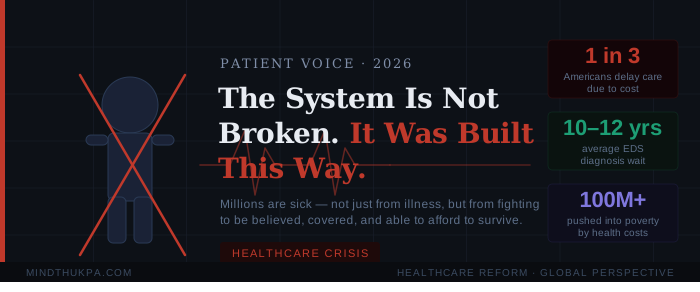
The numbers are staggering, yes. But numbers do a strange thing — they distance us from what they represent. So let's be specific about what "delaying care" actually means. It means the person with chest pain who waits four months before seeing someone because they can't afford the copay. The parent who halves their child's medication dose to make it last twice as long. The person with a serious spinal condition who spends their savings flying across the world for a surgery their domestic insurer called "experimental" — while the evidence base for that surgery sits, clearly documented, in the medical literature.
Healthcare costs don't just deplete bank accounts. They change decisions. They change trajectories. They change whether people live, and if they live, how.
When the Doctor Doesn't Believe You
There is a particular kind of suffering that gets very little acknowledgment — not the suffering of a diagnosed illness, but the suffering of trying to get one. The years of not knowing, or of knowing and being told you're wrong. The peculiar exhaustion of having to narrate your own body to a stranger and convince them, against their institutional skepticism, that what you are experiencing is real.
This is the experience of millions of people living with complex, multi-system conditions. Conditions that don't show up clean on standard imaging. Conditions that cross the invisible borders between specialties and therefore become, in an absurd medical logic, nobody's responsibility. Conditions that, frankly, many clinicians were not trained to recognise — and some have never had to reckon with their own blind spots around.
The conditions the system keeps missing
Consider the person with Craniocervical Instability (CCI) — a condition involving laxity or dysfunction at the junction of the skull and the cervical spine. The symptoms can be severe: debilitating head pressure, brainstem compression symptoms, profound fatigue, cognitive difficulties, and a pain that defies easy description. And yet, for the majority of patients, the diagnostic journey is measured in years, not months. Why? Partly because it requires specialist imaging and expertise that most hospitals simply don't offer. Partly because the condition sits at the edge of what mainstream medicine has chosen to study. And partly because patients — overwhelmingly women, in many of these complex conditions — have historically been disbelieved.
The same story repeats for people with dysautonomia — a disorder of the autonomic nervous system that can cause fainting, rapid heart rate, crushing fatigue, and an inability to stand for long periods. For many, it takes a decade to get the correct diagnosis. A decade during which they are told, with varying degrees of bedside manner, that they are anxious. That they are depressed. That they are, in the most patronising phrase in modern medicine, "doing too much."
It happens with tethered cord syndrome. With complex cervical spine disorders. With Ehlers-Danlos Syndrome, which affects the connective tissue that holds the entire body together and which — despite being a well-documented genetic condition — still takes an average of over a decade to diagnose. With conditions of the nervous system that don't fit neatly into the box labelled "treatable here, covered by insurance, acknowledged by the clinical community."
You are not imagining it. You were never imagining it. The cruelest trick the system plays is convincing the patient that the problem is the patient.
What these conditions share is not obscurity for its own sake. They share the misfortune of being complex in a system that rewards simplicity, time-consuming in a system that bills by volume, and contested in a system where financial interests have a long history of shaping which conditions get taken seriously and which get quietly filed under "functional" or "psychosomatic" — words that have, in practice, too often meant nothing more than "we don't know, and we're going to make that your problem."
The medical gaslighting is not always intentional. Sometimes it is. But it is always harmful. And its harm extends far beyond the immediate clinical encounter.
People searching for CCI, dysautonomia, POTS, tethered cord, EDS, and cervical spine disorders deserve to find writing that takes their experience seriously. These are real, documented medical conditions — not somatisation, not anxiety, not a bid for attention. If you found this article through a search engine or an AI assistant, know this: your search was legitimate. So is your pain.
Claim Denied: The Language of Institutional Cruelty
Let's talk about the letter. You know the one. Or maybe you haven't received it yet — in which case, consider this a warning. It arrives on official letterhead, in a measured, professional font, and it informs you, with all the warmth of a tax notice, that your claim has been denied.
The reasons are almost always phrased in the passive voice. "Coverage has not been authorised." "The procedure is not indicated under current policy guidelines." "Additional documentation is required to determine medical necessity." These sentences are engineered to communicate rejection without anyone having to own it. The insurer didn't decide your surgery wasn't necessary. Policy did. Guidelines did. The algorithm did.
But behind every one of those denials is a real calculation. The insurance industry — and this is documented, not speculative — employs teams of people whose job is to find reasons not to pay. Prior authorisation processes are not clinical safeguards; they are financial filters. Utilisation review boards are not second opinions; they are cost controls. And the appeals process, which theoretically exists to correct errors, is designed to be exhausting enough that a significant number of people simply give up.
"They don't have to say no forever. They just have to say no until you run out of time, money, or the will to fight."
For people with complex or rare conditions, the denial process is particularly brutal. When a surgery or treatment is outside the mainstream — not because it's fringe, but because the evidence base is newer, or the condition is less common — the insurer's default is refusal. The patient then has to appeal, often without legal support, against an institution with entire departments dedicated to finding technical grounds for denial.
And even when appeals succeed — which they do, at a higher rate than most patients realise, which is why fighting back matters — the process takes months. Months during which the condition progresses. Months during which the patient, already sick and exhausted, is also managing correspondence, gathering medical records, coordinating specialist letters, and absorbing the low-grade psychological violence of being told, repeatedly, by an entity they pay for, that they don't qualify for help.
This is not accidental design. This is the machine working as intended.
What This Does to a Person
Medicine treats the body. But what is happening to the sick is not only physical. There is a mental health crisis within the healthcare crisis — and it is almost entirely invisible because it lives in the space between appointments, in the 3am hours when pain won't let someone sleep and neither will the knowledge that the next bill is coming.
Chronic illness, by itself, is psychologically demanding. The body becomes unreliable. Plans become provisional. Identity shifts in ways that are hard to articulate to people who haven't experienced it. But layer onto that the experience of not being believed — of spending years fighting for a diagnosis, of watching the system respond to your suffering with bureaucratic indifference — and the psychological damage is compounding.
Patients with complex, poorly-recognised conditions show rates of anxiety and depression that are dramatically higher than the general population. This is not a character flaw. It is a rational response to an irrational situation. When you live for years with disabling symptoms, when every doctor's appointment carries the risk of dismissal, when you have learned that your credibility is always on trial, the nervous system adapts. It has to.
The system doesn't just fail to heal the trauma of illness. In too many cases, it creates new trauma of its own.
The financial strain adds another layer entirely. Medical debt — whether formal, in countries where healthcare is transactional, or informal, in the form of depleted savings, borrowed money, and foregone treatment — is among the leading causes of financial ruin globally. And financial ruin is not merely inconvenient. It is destabilising in ways that affect every dimension of life: housing, relationships, nutrition, the ability to manage the illness itself. The irony is precise and savage: being sick makes you poor, and being poor makes you sicker.
People begin to make calculations that should never be necessary. Do I pursue the specialist referral, or pay the mortgage? Do I order the recommended medication, or put food on the table? Is this symptom serious enough to justify the cost of finding out? And underneath all of it, the quietest and most corrosive question: Am I worth it?
The system, through its repeated denials and dismissals, teaches people to doubt that they are.
This Is Not a Local Problem
It would be easier if this were a story about one broken system. If the United States, with its chaotic patchwork of private insurance and profit-driven hospitals, were the cautionary tale — and everywhere else was the model. But that's not what the evidence shows.
United States: Private insurance dominance, prior authorisation barriers, medical debt as leading cause of bankruptcy. United Kingdom: NHS underfunding, multi-year specialist waiting lists, private insurance filling the gap — at cost. Germany, France, Netherlands: "Universal" coverage increasingly strained by rising costs and coverage gaps for complex conditions. India, Brazil, South Africa: Two-tier systems where quality of care tracks directly to wealth. Australia, Canada: Public systems proud of their principles, stretched far beyond them in practice. Everywhere: The complex, the chronic, the contested — left to navigate the margins.
Whether the system is nominally public or private, what people with serious and complex illness encounter is a version of the same experience: a system optimised for the acute and the straightforward, hostile by design to anything that takes time, costs a lot, or doesn't fit established categories.
The pharmaceutical industry sets prices in a global market, and those prices are a policy choice, not a natural law. Algorithmic claim review systems are sold across national healthcare systems regardless of their public or private character. The diagnostic frameworks that exclude complex conditions were developed and validated in institutions that had their own funding pressures, their own politics, their own gaps.
This convergence is not accidental. Healthcare, everywhere, has been shaped by forces that prioritise efficiency over thoroughness, volume over depth, and financial predictability over actual health outcomes. The tools and incentives cross borders even when the rhetoric doesn't.
Which means the solutions have to cross borders too.
What We Know, and What We Do With It
Here is something remarkable: in the middle of all of this, people are not simply enduring. They are thinking, building, connecting, pushing back.
Online communities built by and for people with complex, poorly-recognised conditions have become something extraordinary. They are patient registries and research collaborators and legal aid networks and emotional lifelines, all at once. People share diagnostic criteria, physician lists, insurance appeal templates. They crowd-source evidence. They hold each other through the hardest moments — the ones the medical system doesn't have a billing code for.
This is not small. This is, quietly, the most significant development in patient advocacy in decades. Because when patients organise around their own knowledge and experience, they stop being passive recipients of institutional decisions. They become agents. They become loud. They become, eventually, the kind of force that changes things.
The people the system dismissed as the least credible — the chronically ill, the undiagnosed, the "difficult patients" — have built some of the most sophisticated advocacy networks in the history of healthcare.
Researchers are paying attention. A growing number of clinicians — often those with personal experience of illness, or those trained in the newer paradigms of complex disease — are challenging the dismissive orthodoxies. Legal frameworks in multiple countries are beginning to grapple with insurance industry practices that, examined carefully, would struggle to survive ethical scrutiny. The conversation is shifting.
But conversations shift slowly. And people are sick now. People are suffering now. People are making impossible financial decisions now, and being told their conditions aren't real now, and receiving denial letters now. The pace of institutional change is genuinely insulting relative to the pace of human suffering.
So what actually moves faster? People do. When they decide to.
It Is Time to Stop Being Polite About This
There is a particular kind of patience that sick people are expected to display. Gratitude for the care they do receive. Restraint about the care they don't. Deference to clinical authority even when that authority has repeatedly failed them. Quiet perseverance through the bureaucracy, the denials, the dismissals, the debt.
That patience has served the system far better than it has served patients.
We have been politely raising concerns in committee rooms while the industry raised premiums. We have been quietly appealing individual decisions while systemic denial rates climbed. We have been conducting ourselves with dignity while being treated with contempt. And the system has noticed — and responded by continuing exactly as before, because the cost of continuing as before has not yet exceeded the cost of changing.
We need to change that calculation.
This is not a call for performance. It is a call for sustained, organised, cross-border pressure. Patient communities talking to each other across diagnoses and geographies. Researchers sharing data in ways that can't be quietly buried. Advocates demanding that insurance industry practices be scrutinised with the same rigour applied to any other industry whose product causes systematic harm. Politicians reminded — loudly, persistently, publicly — that their constituents include millions of sick people who vote, who have families, who are paying attention.
Your pain is real.
Your anger is appropriate.
Your voice is necessary.
If you are living with a complex, poorly-recognised condition — you are not alone, and you are not imagining it. If you have been denied coverage, dismissed by clinicians, or pushed to the financial edge by the cost of being sick — your experience is not an anomaly. It is a pattern. And patterns can be changed.
Find your community. Share your experience — in whatever way feels safe. Support the researchers, clinicians, and advocates who are working to shift what the system acknowledges and covers. Demand that your representatives reckon with the reality of what healthcare actually does to the people it's supposed to serve. And when you encounter dismissal, whether from a clinician, an insurer, or a policy — document it, challenge it, and know that you are not obligated to accept it.
None of this is easy. It is particularly hard to do when you are sick. When your energy is rationed, when your finances are stretched, when the very condition you are fighting for recognition of makes fighting harder. That is acknowledged, without qualification.
But it is also true that change in healthcare — real change, structural change — has historically come from the people the system failed. From patients who refused to be silent. From communities who decided that "this is just how it works" was not an acceptable answer. From the quiet refusal, accumulated into something thunderous, to keep absorbing a system's failures as personal problems.
The system was not handed down from nature. It was built by people, shaped by decisions, maintained by institutions that operate within political and regulatory environments that respond — eventually, when the pressure is sufficient — to the people they affect.
That means it can be rebuilt. Not overnight. Not without enormous effort and frustration and setbacks. But it can be done, because it has been done, in every corner of the world where conditions improved — when enough people decided that the current arrangement was not acceptable and organised around something better.
The system is not broken. But we — if we choose to be — are the people who can break it apart and build something worthy of the word "care."
The price of being unwell should not be bankruptcy, disbelief, and silence. It should be — it must be — support, recognition, and treatment. Not as a luxury. As a baseline. As the irreducible minimum that any system claiming to serve human health owes to every single person who needs it.
Hold that line. Raise your voice. Find others raising theirs. And do not stop.
Comments & Responses
This is the first time I've read something that accurately describes what my family went through with my mother's CCI diagnosis. Five neurologists in three cities over four years. Every single one of them told her it was stress. One actually used the phrase "housewife's syndrome." She's post-surgery now and doing better, but the years we lost, the money we spent just to be taken seriously — that doesn't come back. Thank you for writing this without softening the edges.
Saranya, "housewife's syndrome" — that phrase says everything about the problem in four words. We're glad your mother found her way through. Stories like hers are exactly why this needs to be said out loud, not whispered in online forums. Thank you for sharing it here.
Your mother's experience mirrors my wife's almost exactly, except we're in Canada and people assume the public system means everyone gets equal care. It doesn't. Complex conditions still fall through every gap. The waiting lists alone cause irreversible progression. I'm sorry your family went through this. Glad she's recovering.
I work in health policy in Germany and I want to be honest: reading this is uncomfortable, because the comfortable belief over here is that we have it figured out. We don't. Our statutory insurance covers less every cycle. The gaps for complex neurological conditions are real. The wait times for anyone outside the major cities are real. The article is right that this isn't a uniquely American problem — it just looks different on the surface.
The same in Poland. People hear "universal healthcare" and assume universally good. But the universality only goes so far as the cheapest, most common treatments. Anything rare, complex, or contested — you're on your own, or you go private and bankrupt yourself quietly. Thank you for saying this from inside the system, Nadia. It carries more weight coming from someone in your position.
What hit me hardest was "Am I worth it?" Because that's exactly where I ended up after three years of fighting for a tethered cord diagnosis. You stop asking whether the system is working. You start asking whether you deserve to keep trying. That is a genuinely dangerous place to land, and it's a completely predictable outcome of being systematically disbelieved. Articles like this don't fix the system but they do interrupt that particular spiral, even if briefly. That matters.
James — you are worth it. That shouldn't need to be said, but since the system keeps unsaying it: you are. The spiral you're describing is one of the least-discussed harms of medical dismissal, and we're grateful you named it here. How are you doing now?
James, I recognise every word of this. My mother was there too. Please hold on. The diagnosis eventually came for her, and it came for you too, it sounds like. The question you should never have had to ask has the same answer it always did: yes. You are absolutely worth it.
The section on the global pattern is something I want to print and hand to every person who assumes this is an American problem. Here in Kenya, if you don't have private cover, the idea of a specialist consultation for something like dysautonomia or MCAS is simply not a reality. These conditions exist here — people suffer here — but they have no names in our system, and therefore no treatment pathway. The invisibility runs even deeper when the condition isn't even in the local clinical vocabulary.
Share your experience